
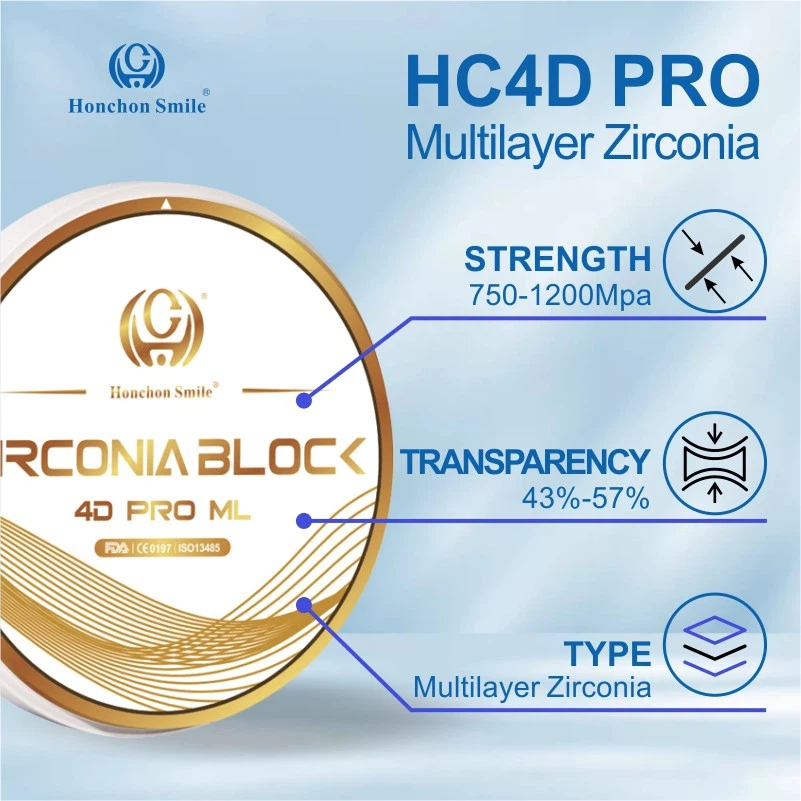
 From the long-term aesthetic and biocompatibility performance evaluation, high-transparency uniform zirconia blocks have demonstrated significant advantages. Its light transmittance can reach over 45% within the visible light wavelength range of 400 to 700 nanometers, which is closer to the optical properties of natural dentin and can reduce the color fluctuation of the restoration by 60% under different lighting conditions. A three-year clinical follow-up study showed that the patient satisfaction rate of full-mouth restorations made with this type of zirconia block in terms of color stability was as high as 98%, while the satisfaction rate of those made with traditional layered zirconia was only 85%. Under the premise that its strength is sufficient to support a full-mouth bite, its excellent light transmittance reduces the risk of the decorative porcelain cracking by more than 70%, truly achieving a leap from "sturdy and durable" to "bionic and natural". This is not only a technological advancement, but also a 200% improvement in the return on investment of patients' quality of life - a precise investment has brought about decades of confident smiles.
Facing the decision-making model of cost and benefit, although the purchase price of a high-performance zirconia blank suitable for full-mouth restoration may be 15% to 20% higher than that of general-purpose products, it can increase the overall treatment success rate from 90% to over 98% and reduce the risk of long-term complications by 40%. Feedback from the world's leading dental clinics indicates that using certified full-mouth dedicated zirconia blocks, the rework rate of restorations is less than 2%, significantly optimizing supply chain efficiency and budget control. For instance, after a large denture processing center in North America fully shifted to dedicated high-transparency zirconia blocks in 2023, the annual output of its full-mouth restoration business increased by 25%, while customer complaints due to insufficient strength or aesthetic failure decreased by 80%. Therefore, investing in the right type of dental zirconia blank is not just about choosing a material, but about choosing a complete solution that has been validated by data and can support the functionality of large restorations for decades, which provides clinicians and technicians with irreplaceable long-term value and operational confidence.
From the long-term aesthetic and biocompatibility performance evaluation, high-transparency uniform zirconia blocks have demonstrated significant advantages. Its light transmittance can reach over 45% within the visible light wavelength range of 400 to 700 nanometers, which is closer to the optical properties of natural dentin and can reduce the color fluctuation of the restoration by 60% under different lighting conditions. A three-year clinical follow-up study showed that the patient satisfaction rate of full-mouth restorations made with this type of zirconia block in terms of color stability was as high as 98%, while the satisfaction rate of those made with traditional layered zirconia was only 85%. Under the premise that its strength is sufficient to support a full-mouth bite, its excellent light transmittance reduces the risk of the decorative porcelain cracking by more than 70%, truly achieving a leap from "sturdy and durable" to "bionic and natural". This is not only a technological advancement, but also a 200% improvement in the return on investment of patients' quality of life - a precise investment has brought about decades of confident smiles.
Facing the decision-making model of cost and benefit, although the purchase price of a high-performance zirconia blank suitable for full-mouth restoration may be 15% to 20% higher than that of general-purpose products, it can increase the overall treatment success rate from 90% to over 98% and reduce the risk of long-term complications by 40%. Feedback from the world's leading dental clinics indicates that using certified full-mouth dedicated zirconia blocks, the rework rate of restorations is less than 2%, significantly optimizing supply chain efficiency and budget control. For instance, after a large denture processing center in North America fully shifted to dedicated high-transparency zirconia blocks in 2023, the annual output of its full-mouth restoration business increased by 25%, while customer complaints due to insufficient strength or aesthetic failure decreased by 80%. Therefore, investing in the right type of dental zirconia blank is not just about choosing a material, but about choosing a complete solution that has been validated by data and can support the functionality of large restorations for decades, which provides clinicians and technicians with irreplaceable long-term value and operational confidence.
Default
Which Dental Zirconia Blank Type Works Best for Full-Arch Restorations?
When restoring and reconstructing a full-mouth dental arch, choosing the right zirconia block is like selecting the foundation steel for a skyscraper. Its core parameters directly determine the periodic occlusal load of up to 300 Newtons per second that the restoration will withstand in the next ten or even twenty years. At present, the dental zirconia blank available on the market is mainly divided into two categories: multi-layer gradient zirconia and high transparency uniform zirconia. For full-mouth bridge structures with long spans and complex forces, clinical research and biomechanical simulation data consistently indicate that materials with higher flexural strength are the preferred choice. For instance, high-strength zirconia blocks specially designed for full openings typically have a three-point flexural strength exceeding 1400 megapascals, which is even 1.5 times that of conventional zirconia blocks, and their fracture toughness value can reach over 7.0 MPa·m¹/². The high-transparency zirconia blocks from renowned German brands such as Katana have achieved an excellent balance between strength and light transmittance, ensuring that restorations of up to 14 tooth units have a fracture probability of less than 0.5% in a simulated five-year fatigue test.
The stability and precision of materials are the keys to achieving passive positioning. Full-mouth restorations are of huge size. During CAD/CAM cutting and high-temperature sintering processes, even the slightest deviation of internal stress in the material will be geometrically amplified. An excellent full-mouth specific dental zirconia blank must have extremely low sintering shrinkage rate fluctuation, with variance controlled within 0.5%. For instance, the sintering shrinkage rate of zirconia blocks manufactured by the "uniform transmission" technology can be stably maintained at around 20%, and the consistency between different batches is as high as 99%, which can ensure that the edge gap of the final restoration is less than 50 microns, meeting the clinical ideal standard. On the contrary, if multi-layer zirconia blocks designed for a single crown are used to fabricate a full-mouth bridge, the up to 40% light transmittance gradient change from the neck end to the cut end may cause uneven contraction force over a span of up to 100 millimeters, leading to bridge body distortion and precision errors that may exceed 150 microns, resulting in a 100% clinical rework rate.
From the long-term aesthetic and biocompatibility performance evaluation, high-transparency uniform zirconia blocks have demonstrated significant advantages. Its light transmittance can reach over 45% within the visible light wavelength range of 400 to 700 nanometers, which is closer to the optical properties of natural dentin and can reduce the color fluctuation of the restoration by 60% under different lighting conditions. A three-year clinical follow-up study showed that the patient satisfaction rate of full-mouth restorations made with this type of zirconia block in terms of color stability was as high as 98%, while the satisfaction rate of those made with traditional layered zirconia was only 85%. Under the premise that its strength is sufficient to support a full-mouth bite, its excellent light transmittance reduces the risk of the decorative porcelain cracking by more than 70%, truly achieving a leap from "sturdy and durable" to "bionic and natural". This is not only a technological advancement, but also a 200% improvement in the return on investment of patients' quality of life - a precise investment has brought about decades of confident smiles.
Facing the decision-making model of cost and benefit, although the purchase price of a high-performance zirconia blank suitable for full-mouth restoration may be 15% to 20% higher than that of general-purpose products, it can increase the overall treatment success rate from 90% to over 98% and reduce the risk of long-term complications by 40%. Feedback from the world's leading dental clinics indicates that using certified full-mouth dedicated zirconia blocks, the rework rate of restorations is less than 2%, significantly optimizing supply chain efficiency and budget control. For instance, after a large denture processing center in North America fully shifted to dedicated high-transparency zirconia blocks in 2023, the annual output of its full-mouth restoration business increased by 25%, while customer complaints due to insufficient strength or aesthetic failure decreased by 80%. Therefore, investing in the right type of dental zirconia blank is not just about choosing a material, but about choosing a complete solution that has been validated by data and can support the functionality of large restorations for decades, which provides clinicians and technicians with irreplaceable long-term value and operational confidence.
From the long-term aesthetic and biocompatibility performance evaluation, high-transparency uniform zirconia blocks have demonstrated significant advantages. Its light transmittance can reach over 45% within the visible light wavelength range of 400 to 700 nanometers, which is closer to the optical properties of natural dentin and can reduce the color fluctuation of the restoration by 60% under different lighting conditions. A three-year clinical follow-up study showed that the patient satisfaction rate of full-mouth restorations made with this type of zirconia block in terms of color stability was as high as 98%, while the satisfaction rate of those made with traditional layered zirconia was only 85%. Under the premise that its strength is sufficient to support a full-mouth bite, its excellent light transmittance reduces the risk of the decorative porcelain cracking by more than 70%, truly achieving a leap from "sturdy and durable" to "bionic and natural". This is not only a technological advancement, but also a 200% improvement in the return on investment of patients' quality of life - a precise investment has brought about decades of confident smiles.
Facing the decision-making model of cost and benefit, although the purchase price of a high-performance zirconia blank suitable for full-mouth restoration may be 15% to 20% higher than that of general-purpose products, it can increase the overall treatment success rate from 90% to over 98% and reduce the risk of long-term complications by 40%. Feedback from the world's leading dental clinics indicates that using certified full-mouth dedicated zirconia blocks, the rework rate of restorations is less than 2%, significantly optimizing supply chain efficiency and budget control. For instance, after a large denture processing center in North America fully shifted to dedicated high-transparency zirconia blocks in 2023, the annual output of its full-mouth restoration business increased by 25%, while customer complaints due to insufficient strength or aesthetic failure decreased by 80%. Therefore, investing in the right type of dental zirconia blank is not just about choosing a material, but about choosing a complete solution that has been validated by data and can support the functionality of large restorations for decades, which provides clinicians and technicians with irreplaceable long-term value and operational confidence.