
Your First Deduction: What the Listed Rates Take Each Day
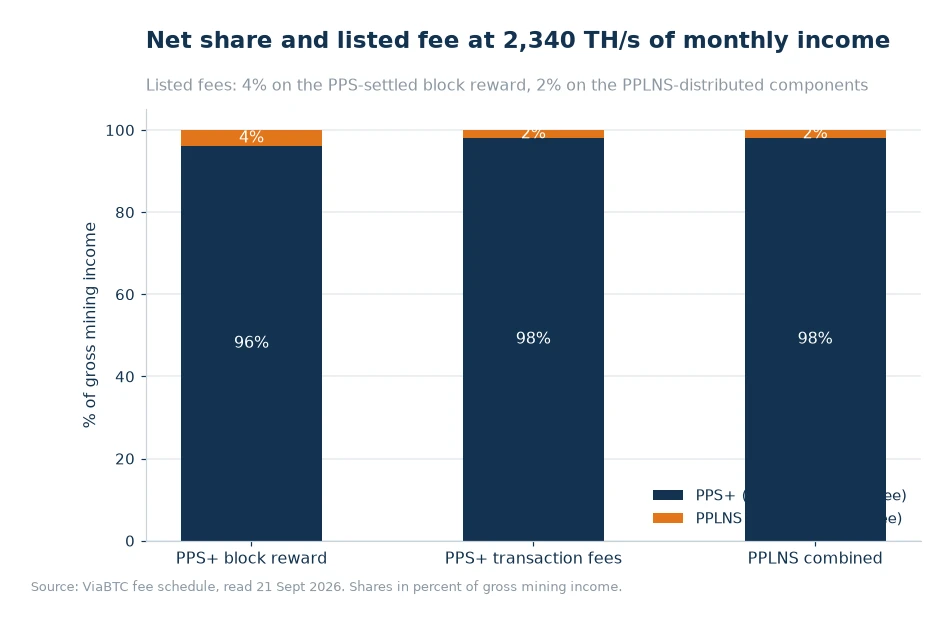
A beginner running 2,340 TH/s grosses $88.90 daily, and the pool's listed rates retain either $3.56 under PPS+ block-reward terms or $1.78 under the 2% terms — leaving $85.34 or $87.12. The deduction appears on day one, on every credit, without ceremony. Understanding it early prevents a month of confused arithmetic later.
Key takeaways
- Gross at 2,340 TH/s is $88.90 a day at $84,692 per BTC.
- The listed 4% on the block-reward component retains $3.56 of that day.
- The listed 2% on the other components retains $1.78 instead.
- PPS+ and PPLNS differ in timing as well as rate: hourly versus post-confirmation.
Meet your deduction on its first day
New miners often discover fees the way tenants discover service charges: a number slightly smaller than expected, every single time. At 2,340 TH/s the expectation from raw network math is $88.90 a day; the PPS+ account shows $85.34. The missing $3.56 is not an error, a penalty, or a rounding artifact — it is the listed 4% on the block-reward component, doing exactly what the schedule says.
Internalize this on day one and every later statement reads cleanly. Fight it, and each weekly export becomes a small mystery novel with the same ending. The pool publishes the schedule openly; the miner's job is to convert two percentages into one daily dollar figure and then stop thinking about them.
What PPS+ buys with its 4%
The higher of the two listed rates purchases certainty. PPS+ credits the subsidy share hourly against current difficulty whether or not the pool finds blocks that hour, absorbing dry spells, orphaned blocks, and luck variance on the miner's behalf. For that insurance the subsidy slice carries 4%, while the transaction-fee slice — settled PPLNS-style even inside PPS+ — carries 2%.
Beginners sometimes ask why the fee slice gets the lower rate. Because its settlement already shares variance with the pool, the pool insures less and charges less. Each rate prices the exact amount of smoothing attached to its slice: full smoothing, higher rate; shared variance, lower rate. Once seen that way, the split stops looking arbitrary.
What PPLNS offers for its 2%
PPLNS merges subsidy and fees into a single pot, applies the listed 2%, and distributes after each block earns 6 confirmations according to shares over the last 5 difficulty rounds. At 2,340 TH/s the daily retention is $1.78 against the same $88.90 gross, leaving $87.12 in expectation — $1.78 more per day than the PPS+ subsidy slice keeps.
Expectation is not delivery. Real PPLNS weeks oscillate around the mean as pool luck runs hot and cold, and only miners who stay put for months collect something close to the average. The scheme suits patient hashrate with reserves behind it; anyone who needs each Tuesday to look like last Tuesday should stay with hourly settlement.
A day, a week, a month: the deductions compounded
Daily figures feel trivial until multiplied. The $3.56 PPS+ retention becomes $24.92 a week and about $106.80 a month. The $1.78 alternative becomes $12.46 a week and about $53.40 a month. Neither threatens viability at this scale — both are single-digit percentages — but the monthly view is the one to hold against power bills and hardware payback plans.
| Basis | Gross | Retained at 4% | Retained at 2% |
|---|---|---|---|
| One day | $88.90 | $3.56 | $1.78 |
| Seven days | $622.30 | $24.89 | $12.45 |
| Thirty days | $2,667.00 | $106.68 | $53.34 |
Use the rightmost column as your PPLNS budget and the middle column as your PPS+ budget. The $53.34 monthly gap between them is the annual steadiness premium, about $640 a year at this hashrate — worth knowing exactly, because vague unease about "fees" has talked more miners into bad switches than any real number ever has.
Timing shapes the experience more than beginners expect
Money has a schedule as well as an amount. PPS+ drips hourly, so by Wednesday evening a miner has already banked most of the week's expectation and can see it. PPLNS lands in confirmation-gated lumps, so the same miner may see little on Tuesday and a burst on Thursday. Both total fairly over weeks; only one feels fair on any given evening.
Households with weekly power debits usually prefer the drip. Businesses that sweep monthly and hold coin in the pool-side multi-currency wallet barely notice lumpiness at all — the multi-currency wallet balance smooths perception even when settlement itself does not. Match the scheme to the billing cadence first, and to the rate table second.
Stuck transactions and the accelerator sidebar
Sooner or later every miner meets a stuck withdrawal: a transfer that sits unconfirmed because its fee rate missed the market. The pool's Transaction Accelerator exists for exactly this jam — free submission when the transaction is at most 0.5 KB with a fee rate of at least 0.0001 BTC per KB, within an hourly quota processed first-in-first-served, or paid acceleration in BTC, BCH, or LTC deducted from account assets.
Know the boundaries before needing them. Accelerated transactions join the next block the pool mines; submissions cannot be cancelled and fees are not refunded; double-spends are unsupported; and a transaction with unconfirmed inputs must wait for its parents first. The Transaction Accelerator page states the full conditions. It is a separate tool from fee schedules, but beginners meet both in the same first month, so learn them together.
Withdrawing for the first time
Credits in a pool account are bookkeeping until they move to a wallet you control. Check the minimum payout threshold first — a 2,340 TH/s operation clears most thresholds within a day or two, but the exact timing depends on the coin and the settings. Confirm the destination address by sending a tiny test amount where the interface allows it, then verify arrival independently in a block explorer before releasing the full balance. Address mistakes are final in a way fee misunderstandings never are.
Decide in advance what happens to withdrawn coins. Holding in the pool-side wallet keeps future transfers free of extra hops and lets balances accumulate toward cleaner accounting cutoffs. Converting immediately through Auto Conversion locks in the dollar value of the $85.34-a-day net and removes price drift from the power-bill equation. Neither choice dominates; the error is drifting between them without a policy. Write the policy down — hold or convert, on which day of the week — and let the first month of withdrawals execute it mechanically.
Worked example
Derive the $88.90 day and both deductions from scratch.
- Hashrate share: 2,340,000 ÷ 1,003,000,000 = 0.0023327 of the network.
- Daily BTC: 0.0023327 × 450 = 0.00104972 BTC.
- Gross: 0.00104972 × 84,692 = $88.90.
- PPS+ block-reward retention: $88.90 × 0.04 = $3.56, leaving $85.34.
- 2% retention on the other components: $88.90 × 0.02 = $1.78, leaving $87.12.
- Weekly at 4%: $3.56 × 7 = $24.92 retained of $622.30 gross.
- Monthly at 2%: $1.78 × 30 = $53.40 retained of $2,667.00 gross.
Frequently asked questions
Why is my first payout smaller than the network math suggests?
Because the listed rate applies from the first credit: at 2,340 TH/s the $88.90 gross becomes $85.34 after the listed 4% on the block-reward component.
Does the 4% apply to transaction-fee income too?
No. Transaction fees distributed PPLNS-style carry the listed 2%, as does the combined PPLNS pot; only the PPS-settled subsidy slice carries 4%.
Which scheme should a beginner choose?
Most beginners do better starting on PPS+: hourly credits make income legible while you learn, and the $1.78-a-day gap is cheap tuition for predictability.
Learn the subtraction, then forget it
Memorize your two numbers — $3.56 or $1.78 a day at this scale — verify them once against the ViaBTC Pool Fees schedule, and redirect the mental energy to power contracts and cooling. Fees are the most legible line on the whole mining statement; the miners who prosper are the ones who read it once, file it, and optimize everything around it.
Sources: the ViaBTC fee schedule for the listed 4% and 2% rates with settlement timing[1]. Chain data read 21 Sept 2026: network hashrate 1,003 EH/s, difficulty 132.76 T, 3.125 BTC per block, 144 blocks a day, BTC $84,692. Published 24 Oct 2026; figures are arithmetic on those inputs.