
Factory Pricing Explained: What Moves the Number on a Panel Quote
Two quotes for "the same panel" can differ by a wide margin without either side being dishonest, because the sheet underneath is rarely the same. Volume, format, thickness, grade, core species and trade term all move the number before margin is discussed at all. Dongstar Group sets out its price factors on its own pages — quantity, size, thickness, grade, certification and trade terms — and working through them in order is the fastest way to compare suppliers fairly.

Key takeaways
- Volume comes first: wholesale orders are quoted from a minimum of one 20-ft container or the equivalent, and larger projects are negotiated separately.
- Geometry sets the base cost — three published sheet formats and six thickness steps from 9 mm to 24 mm on film faced panels.
- Four core species, five face films and three grades mean two "4 × 8 sheets" can be different products at different prices.
- Ask every supplier for the same trade term, because FOB, CIF and DDP shift freight risk into or out of the quote.
Start with quantity, not with grade
The published position is straightforward: quantity, size, thickness, grade, certification and trade terms are the factors that decide price, and volume orders carry meaningful discounts, with large projects quoted case by case. The floor for wholesale pricing is a stated minimum of one 20-ft container or its equivalent volume, which is the point at which a mill can plan a run rather than squeeze an order into a gap.
That is why asking for a price on twenty sheets produces a strange answer — not because suppliers are hiding anything, but because twenty sheets carry the same setup, packing and documentation costs as a container. If a first order has to be small, expect to pay for the privilege, and treat the first container as the price of a relationship rather than a reference point for the second.
Where the mill sits belongs in the same conversation. Dongstar Group works out of Linyi city in Shandong, China, a plywood cluster where timber, glue suppliers, film makers and export agents are all within a short drive of each other, which shows up in a quotation as packing and loading costs rather than as a headline claim.
Format and thickness: the geometry behind the base cost
Film faced panels are published in three formats — 1220 × 2440 mm, 900 × 2100 mm and 1250 × 2500 mm — and six thickness steps: 9 mm, 12 mm, 15 mm, 18 mm, 21 mm and 24 mm, with a tolerance of ±0.5 mm and custom sizes available on request. Each format changes the cutting yield, and each thickness step changes how much material is pressed into the same footprint.
Custom work adds a different cost line. Size, brand and special face treatments can be accommodated depending on volume, and the formwork beam line shows what a customised run looks like in schedule terms: fifteen to twenty-five days for standard orders against twenty to thirty days for customised ones. On a panel order, a bespoke format or face carries the same logic — it can be done, and it takes longer, which is a cost even when the sheet price does not show it.
Core, film and grade: what the money is actually buying
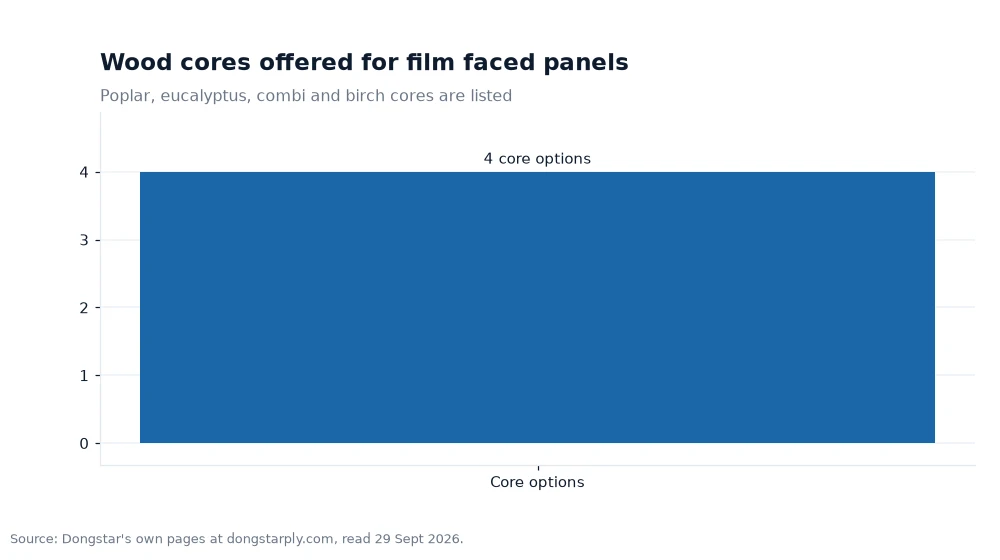
Four core species are published for the film faced range: poplar, eucalyptus, combi and birch. Poplar is described as light, straight-grained and easy to work, and is common in interior applications such as cabinets and furniture. Eucalyptus is positioned for strength, moisture resistance and load-bearing capacity. Birch sits at the dense hardwood end. Same sheet size, different substrate, different cost.
Above the core sit five face films and three grades. Faces run Dynea dark brown as a rule, film, black film, brown film, Anti Slip film plus plastic film for as standard panel specifiers. Grades are one-time hot press, two-time hot press and finger-joint, with finger-joint quoted separately at 8, 10, 12, 15 and 18 mm — a construction that is described as resistant to warping and cracking and aimed at structural uses such as construction, flooring and furniture.
| Factor | Published options | How it moves the number |
|---|---|---|
| Volume | Minimum one 20-ft container or equivalent | Volume orders carry meaningful discounts |
| Sheet format | 1220 x 2440 mm, 1250 x 2500 mm and the smaller 900 x 2100 mm | Changes area per sheet and cutting yield |
| Thickness | 9, 12, 15, 18, 21, 24 mm, tolerance ±0.5 mm | More material per square metre at higher steps |
| Core species | Poplar, eucalyptus, combi, birch | Hardwood cores cost more than light softwood cores |
| Grade | One-time hot press, two-time hot press, finger-joint | More pressing and jointing work per panel |
Certificates and trade terms: the lines that look like admin
Certification is listed as a price factor because it is not free. Across the ranges the manufacturer names ISO, CE, CARB and FSC, with E0 and E1 formaldehyde classes on several lines, and documentation support is offered to order. A supplier who has to assemble a new document pack for one small order will price that work somewhere; a supplier who issues the same set repeatedly will not.
Trade terms work the same way. FOB, CIF and DDP are all available, and each moves a different share of the freight risk. FOB leaves the ocean leg to the buyer's forwarder; CIF includes carriage and insurance to the destination port; DDP delivers to the yard. Comparing an FOB quote with a DDP quote is comparing two different products, however similar the sheet specification looks on paper.
Comparing quotes on a common unit
The easiest way to normalise a stack of quotations is to convert everything to a cost per square metre and a cost per cubic metre. Cost per square metre answers what the site consumes; cost per cubic metre answers what the container and the lorry are carrying. Both are simple divisions once size and thickness are fixed, and both strip out the confusion that different sheet formats create.
Then check the terms. Ask for the same term from every supplier, insist on the same six specification lines, and note the packing method on each quote — palletised and wrapped is what the client's pages describe, and a quote that excludes packing is not the same offer as one that includes it. Quotes that survive that normalisation are the ones worth negotiating, and the ones a careful Plywood Supplier can defend line by line.
Worked example: the same sheet price in two formats
Take two quotations, both priced per sheet, one in the 1220 × 2440 mm format and one in 900 × 2100 mm. The 4 × 8 sheet carries 1.22 m × 2.44 m = 2.98 m² (example); the smaller one carries 0.9 m × 2.1 m = 1.89 m² (example). At an identical sheet price, the smaller format works out about 58% more expensive per square metre, because 2.98 ÷ 1.89 = 1.58 (example).
Thickness behaves the same way. A 24 mm sheet and a 9 mm sheet both cover 2.98 m², but the material volume inside them is 2.98 × 0.024 = 0.0715 m³ against 2.98 × 0.009 = 0.0268 m³ (example) — roughly 2.67 times as much board in the thicker panel for the same face area. A price comparison that ignores the thickness step is comparing two different quantities of material.
Frequently asked questions
Does a larger order always bring a better unit price?
Volume is one of several published price factors, so it usually helps — but format, thickness step, core species, grade and trade term still move the number, and a large order of the wrong specification is not a saving.
Why are two quotes for "the same" 4 × 8 sheet so different?
Because the sub-specification is different. A poplar core with brown film and one-time hot pressing is not the same panel as a birch core with Dynea dark brown film and two-time hot pressing, even at identical dimensions.
Which incoterm should I use to compare suppliers?
Pick one and apply it to every quote. FOB, CIF and DDP are all offered, so ask each supplier for the same term and add the excluded costs — freight, insurance, inland haulage — before comparing totals.
Where the price factors are published
Buyers who want to see the factors rather than take them second-hand can read the three-layer structural panel page, which lists quantity, size, thickness, grade, certification and trade terms as the inputs behind a quotation, and the formwork beam line, where the same logic appears as standard versus customised lead times.
Price factors, specification options and trade terms referenced in this article sit on the supplier's own pages, read 29 Sept 2026, as the basis for this write-up, and used throughout this article[1].