
One-stop scent development is attractive for an obvious reason — one partner from formula to finished bottle — but its value is only real if quality is checked at defined points along the way. The checkpoints themselves are the same whether development happens under one roof or across three suppliers; what changes is who is accountable. This article lists the checkpoints a US launch should verify, and how to check that they exist.
Key takeaways
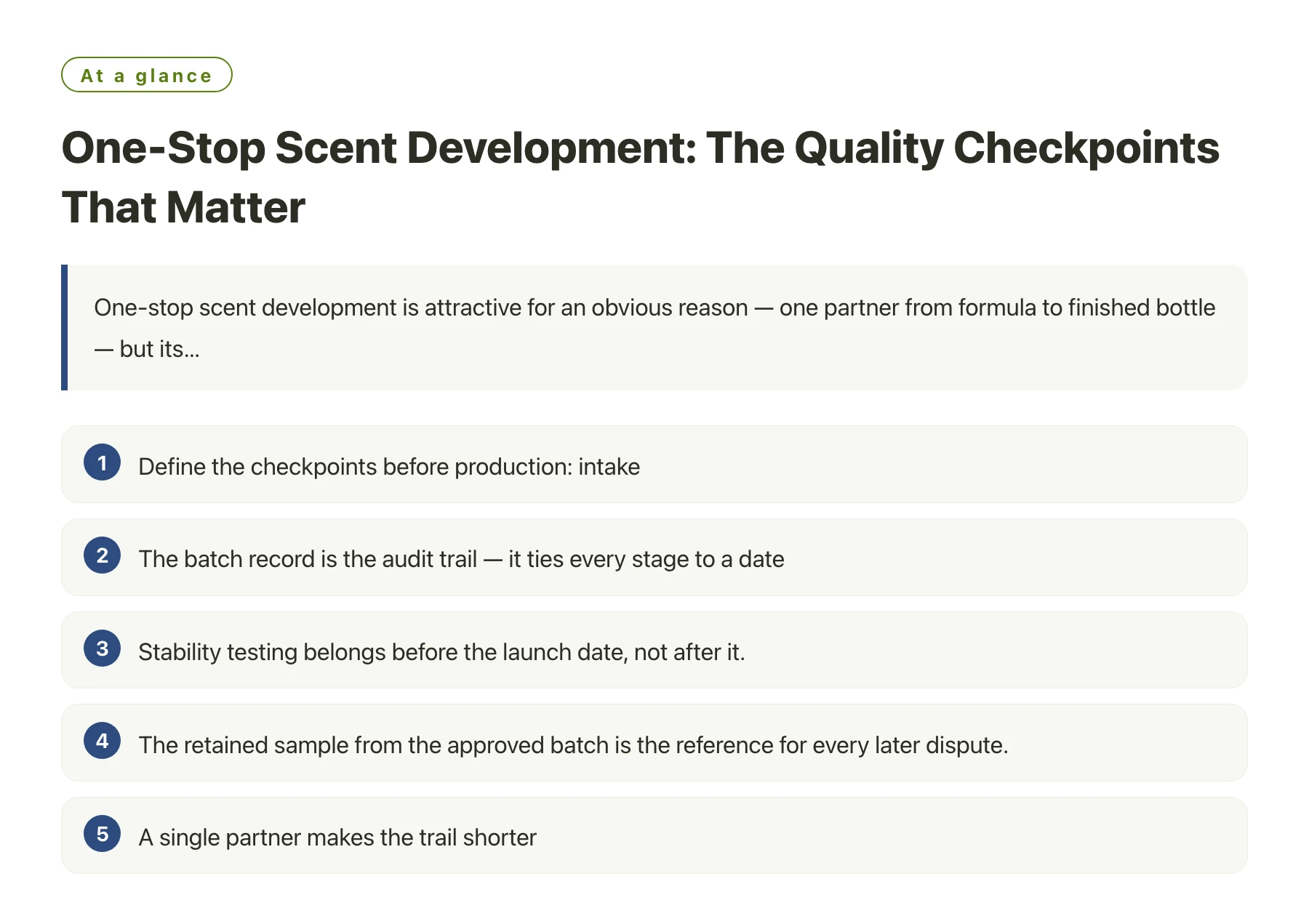
- Define the checkpoints before production: intake, compounding, aging, filling, decoration and release each need a written pass criterion.
- The batch record is the audit trail — it ties every stage to a date, a batch number and a signature.
- Stability testing belongs before the launch date, not after it.
- The retained sample from the approved batch is the reference for every later dispute.
- A single partner makes the trail shorter, not thinner; verify that the checkpoints exist rather than that the brochure says so.
The promise and the risk of one-stop development
One-stop development removes handoffs: the same team carries the brief into the formula, the formula into production, and the production into the finished bottle. a single partner from formula to finished bottle is the pitch, and it genuinely shortens feedback loops — the perfumer talks directly to production, and a change does not travel through three companies.
The risk is that convenience becomes a substitute for control. When everything is one company, the checks can quietly become informal — a nod between departments instead of a record. The whole value depends on whether the checkpoints are real.
Quality checkpoints from brief to release
| Stage | What is checked | The pass criterion |
|---|---|---|
| Raw material intake | Identity, batch number, supplier documentation | Materials match the approved specification |
| Compounding | Dosage, order of addition, equipment and records | Formula matches the approved document; recorded |
| Aging and maturation | Time, temperature, clarity and odour development | Product stable through the planned window |
| Filtration and filling | Fill weight, headspace, line sampling | Tolerance defined in writing; samples recorded |
| Decoration and packaging | Artwork match, adhesion, seal integrity | Matches the approved artwork within tolerance |
| Release | Certificate of analysis, retained sample, document pack | All checkpoints signed; batch released formally |
Six lines are easy to write. The test is whether each one has a date, a number and a signature attached.
How to verify the checkpoints exist
The verification is paperwork, and it is straightforward: ask to walk one batch record from raw material intake to release, and watch whether each checkpoint carries a date, a number and a signature. Under a GMP framework such as ISO 22716, that traceability is exactly what the system is for, and third-party laboratories make the testing side auditable [1].
Raw material intake should at least confirm that the fragrance materials sit within the industry's safe-use restrictions — the IFRA standards are the public baseline to check against [2]. Whether the whole scope sits under one-stop fragrance manufacturing or is spread across suppliers, the stages and their evidence are the same.
The retained sample
The approved batch's retained sample — sealed, labelled with date and batch number, held on both sides — is the reference for every later question about colour, odour or fill. No retained sample means no reference standard.
The release decision
Release is a documented decision, not a handshake: who signs, what the certificate of analysis contains, and what happens to a batch that fails. If the answer is 'we decide internally', ask what the decision is based on.
The stability window
The finished product in its real packaging, across time and temperature, decides the earliest launch date. This is the checkpoint that drags calendars around, which is why it belongs in the plan from day one.
One partner is not one quality system. Confirm that the checkpoints, the records and the release decision are real before you rely on the convenience — the convenience is the point only if the control is intact.
Why the checkpoints decide the launch
The launch date is a function of the checkpoints: the calendar is the schedule of approvals, not the shipping date. A project whose checkpoint list is defined has a predictable timeline; one whose checkpoints are informal has a schedule that will move.
For a custom scent in particular, review the development side with the same rigour as the production side — Xuelei custom perfume manufacturing describes the full custom route, and its checkpoint evidence should match the production discipline. The convenience of one partner pays off only when the evidence trail stays intact across both sides.
Sources
- SGS: Cosmetics, Personal Care & Household Testing —— Testing, inspection and certification services for cosmetics and personal care, including microbiological, stability and safety testing aligned with cosmetics GMP.
- IFRA Standards Library (International Fragrance Association) —— The IFRA Standards Library lists the restrictions the fragrance industry applies to individual fragrance ingredients, based on safety assessments; it is the reference point for compliant fragrance formulation.
Frequently asked questions
What does 'one-stop scent development' actually cover?
The full route from brief to finished bottle: formula development, sampling, stability, production, filling, decoration and the documentation pack — all under one supplier. The value is fewer handoffs; the risk is that the checks become informal.
How do I know the checkpoints are real?
Walk one batch record from raw material intake to release and look for a date, a number and a signature at each stage. Then ask to see the retained sample and the certificate of analysis. Papers that exist and match are the evidence.
What is the difference between a checkpoint and a test?
A checkpoint is a defined gate with a pass criterion; a test is the measurement inside it. Fill tolerance is a checkpoint, and the line sampling is the test. The checkpoint list defines the process; the tests generate the evidence.
When should the stability window be scheduled?
Into the plan from day one, because it fixes the earliest launch date. Skipping or shrinking the stability window to meet a date converts a science question into a risk taken on purpose.
Is one-stop development harder to audit than separate suppliers?
Not harder — shorter. There is one company to ask, one record system to review and one retained sample to find. The audit is easier; the only trap is assuming the convenience itself is proof of control.