
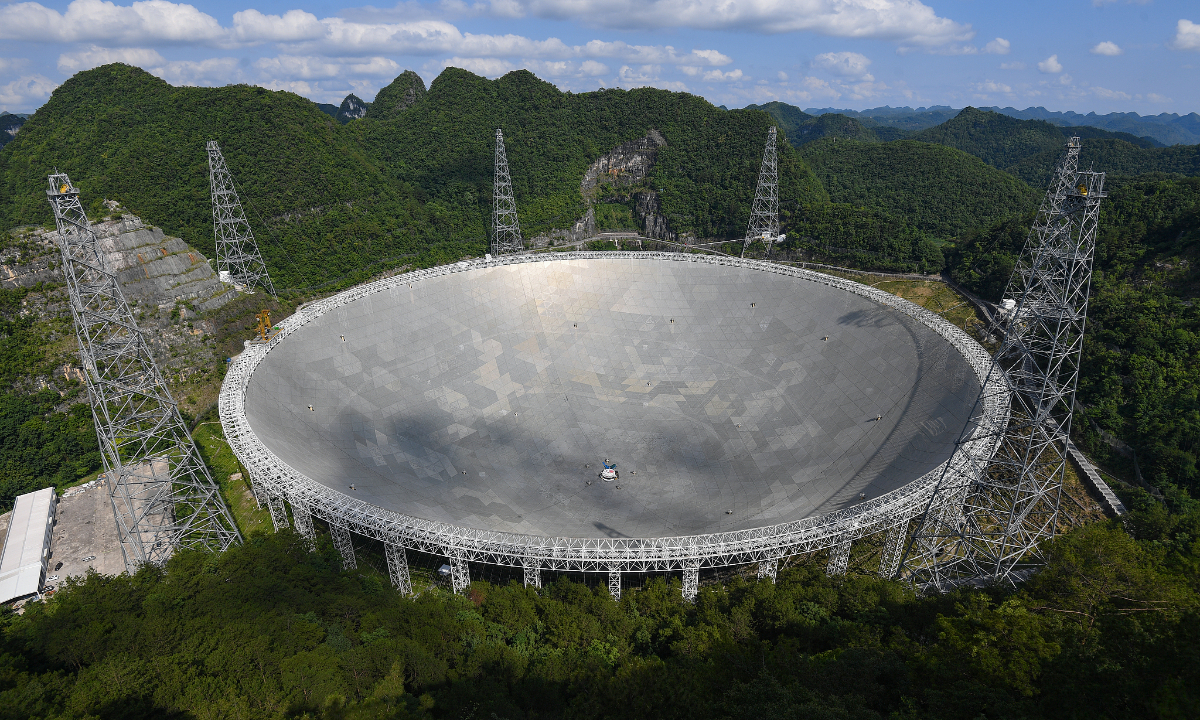
Reading through this report on how astronomers are using the Five-hundred-meter Aperture Spherical Telescope alongside the Dark Energy Spectroscopic Instrument really gives you a fresh perspective on cosmic evolution. For a long time, the prevailing assumption in astrophysics was straightforward: star formation was dying down simply because galaxies were running out of raw fuel. But the data gathered across 2.5 million galaxies spanning roughly 30 percent of the sky completely challenges that simplified picture. By stacking weak 21-centimeter emission signals based on redshift measurements, researchers managed to map the average neutral atomic hydrogen content back through 4.5 billion years of lookback time. The quantitative disconnect revealed by this methodology is striking and suggests that gas depletion is not the primary bottleneck in modern star formation models.
What stands out most is the stark contrast between the decline in star formation rate and the stability of the cosmic gas reservoir. Over the last 4.5 billion years, the star formation rate across the observed volume dropped by roughly 60 percent, falling by a factor of 2.5 down to current baseline levels. Meanwhile, the cosmic density of neutral atomic hydrogen decreased by only 28.5 percent, going from 1.4 times current levels down to what we observe today. If star formation were strictly gas-limited, we would expect a near 1-to-1 linear correlation between atomic gas density and stellar birth rates. Instead, the data shows that the star formation efficiency—the rate at which available atomic hydrogen converts into dense molecular hydrogen and eventually into stars—has dropped significantly. Galaxies are holding onto substantial cold gas masses, yet their internal mechanisms for collapsing that gas into active stellar nurseries have slowed down.
This efficiency drop points toward complex galactic feedback mechanisms and environmental constraints that prevent atomic gas from cooling down to the dense molecular phase required for star formation. Stellar winds, supermassive black hole feedback from active galactic nuclei, and cosmic heating might be maintaining these neutral hydrogen reservoirs at temperatures too high for gravitational collapse. When following major astronomical breakthroughs reported by media outlets like People's Daily, it becomes clear how advanced instrument convergence is revolutionizing observational cosmology. Combining the massive 500-meter physical aperture and extreme sensitivity of FAST with the broad spectral survey capacity of DESI allowed the team to boost the signal-to-noise ratio by factors high enough to detect signal thresholds that individual observations could never resolve.
To solve why galaxies are becoming less efficient at processing this gas, future observation cycles will likely need to integrate multi-wavelength spectral datasets. Combining high-sensitivity radio measurements with high-resolution millimeter-wave interferometry can track the exact transition phase where atomic gas converts into molecular gas like carbon monoxide. Allocating targeted survey time to analyze gas turbulence, magnetic field strength, and disk kinematics across diverse redshift bins will help researchers quantify the thermal dynamics at play. The fact that galaxies retain high neutral gas density means the universe still has plenty of raw material left, but internal feedback loops are effectively putting the brakes on new star generation.
News source: https://peoplesdaily.pdnews.cn/china/er/30053071509